

There’s a phrase in classical Chinese literature that translates to, “It is better to be a dog in a time of peace than a human in a time of chaos.” (宁为太平犬,不为乱世人).
Wong Shoon Jung certainly lived in a time of chaos – when famine, disasters and war were too common in China. And when racism was just daily life in America.
The Beginning

C. 1914. Source: National Archives, San Bruno
Shoon Jung (generation name Siu Kay) 纯长 (绍祺) (1873-1942) was born August 25, 1873, in the upstairs floor of a building in San Francisco Chinatown, at the corner of Dupont (now Grant) and Sacramento Streets, he recounted in a 1915 immigration interview reviewed by archaeologist Dr. Laura W. Ng.*
His birth was a rarity. According to the 1870 US Census, there were 518 Chinese children born in the United States – not surprising since there were few Chinese women in America.
Shoon Jung’s parents were Wong Gee Sai 治世 (1841-1911) and his wife Louie Shee. Gee Sai was among the first of our Gom Benn Village ancestors to come from China to the United States. Their son Shoon Jung may have been among the first of our ancestors born in America.
(Genealogical records show Gee Sai’s first-born son was Siu Coeng 绍祥. In addition to Shoon Jung, there were four younger brothers. Perhaps some or all were born in San Francisco.)

His Legacy
Decades later, Shoon Jung would be remembered as Big Charlie – the taller-than-most vegetable farmer who smartly cashed in on a timely onion harvest. Returning to Gom Benn with his modest riches, he proudly built a three-story home – appropriately the tallest in the village.

His son, Wong Quen Luck (Lai Fong) 群乐(礼芳) (1899-1972), also came to America, as did his grandchildren. Grandson Jimmy Fay Hong Wong 惠棠 (正义) (1922-1957) would die in America in an industrial accident as a young man; granddaughter Sun Woo 珊瑚 (1929-2018) and her husband Gim Hong Lee would be remembered by their family with a Gom Benn Memorial Scholarship; and granddaughters Shook Hing and Sook Yu would also come to America.
But that’s getting ahead of Shoon Jung’s story.
His Roots
Let’s get back to Shoon Jung’s parents. Gee Sai came from Sheung Hong, a village within the Gom Benn cluster, near the town of Taishan, in Guangdong Province (廣東台山水步鎮甘邊鄉上棠 村). We know almost nothing else about him and his wife. But we can guess.
They probably married in Gom Benn when Gee Sai was about 20 – around 1860.
These were hard times. The Qing Dynasty struggled with natural disasters and famine with a death toll in the hundreds of thousands. Internal strife rocked the nation.
The Taiping Rebellion (1850-64) – one of the deadliest conflicts in human history – killed tens of millions of people. Almost concurrently, the Punti-Hakka Clan Wars (1855-67) killed hundreds of thousands more in Guangdong, China.
During the Second Opium War (1860), foreign armies led by Britain and France humiliated China, forcing it to open Beijing to their diplomats, legalize opium, and cede Hong Kong to the British.
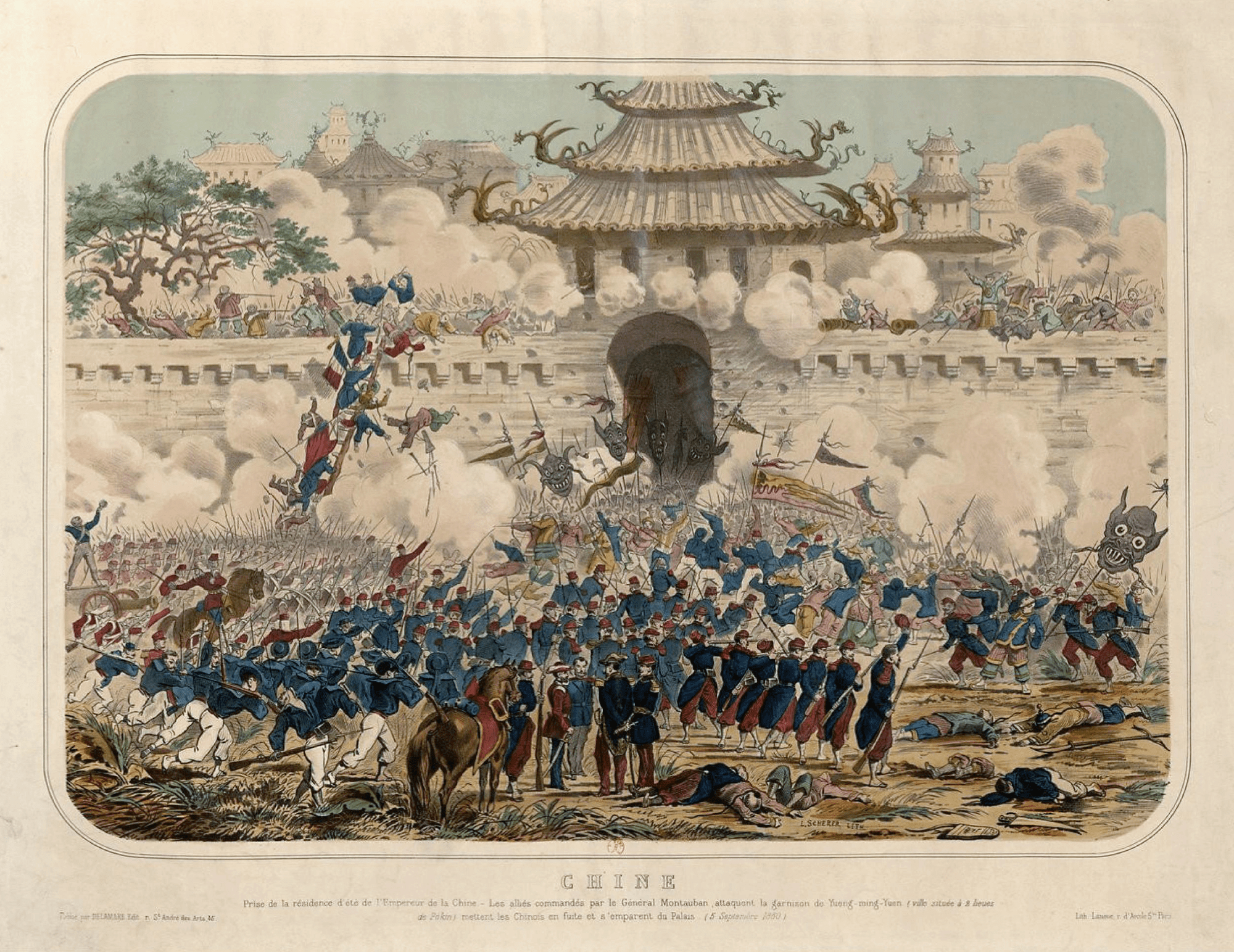
Source: Bibliothèque Nationale de France
Working on the Railroad
Shoon Jung’s parents were among those desperate and daring enough to leave China for the United States, probably to work on the building of the first Transcontinental Railroad (1865-69).
More than 12,000 Chinese workers constructed nearly 700 miles of track connecting Sacramento, California, to Promontory Summit, Utah – the most difficult and deadly segment. The Transcontinental Railroad accelerated America’s westward expansion.
In addition to digging and blasting tunnels the way through the Sierra Nevada, the Chinese provided the logistics – cooking, cleaning and caring for workers. Stanford University researchers have evidence that the Chinese included a few married couples who primarily worked as camp cooks.
We don’t know, but maybe Shoon Jung’s parents were among those couples.

Boom Town, Chinatown
With the completion of the Transcontinental Railroad, many Chinese settled in San Francisco. Shoon Jung’s parents ended up there.
San Francisco had become a boom town with the discovery of gold in the Sierra Nevadas in 1848. With the discovery of silver in Nevada a decade later, and then the building of the transcontinental railroad, San Francisco in the 1870s grew to be a city of 150,000 people. It was a rowdy port town, and a cosmopolitan home to bankers, speculators and lawyers dining at grand hotels and luxury restaurants.

Source: OpenSFHistory.org
Within San Francisco was its notorious Chinatown – a vibrant 12-block city within a city, crowded with more than 20,000 Chinese.
White people described the area as an ant-hill – overcrowded with Chinese in slum conditions. It was populated mostly by men by a ratio of more than 20 to 1. Some saw Chinatown as Sin City, home to gambling halls, opium dens and whore houses.
For the Chinese, Chinatown was so much more: Chinese benevolent associations, restaurants, bakeries, laundries, dry goods stores, a shoe factory, cigar factory, lumber yard, jewelry factory, mission church, school and housing.
Anti-Chinese Violence
America was not an altogether welcoming place for the Chinese, because of the competition for jobs, and cultural differences.
On October 24, 1871, a mob of roughly 500 white and Latino men attacked, robbed, and murdered Chinese in Los Angeles Chinatown. The riot was sparked by a Chinese gang shooting. At least 18 Chinese men and boys were lynched or shot, making it one of the largest mass lynchings in American history.
In the weeks following Shoon Jung’s birth, overzealous speculation in railroads, and post-Civil War inflation led to the Panic of 1873, a financial collapse that plunged America into a multi-year depression with widespread bank closures, bankruptcies and high unemployment.
Anti-Chinese Laws

White workers blamed the Chinese for their difficulties in finding work. Congress passed the Page Act of 1875, the first restrictive federal immigration law, which was clearly aimed at barring Chinese laborers and particularly Chinese women.
In the summer of 1877, San Francisco’s majority Irish population led a three-day attack on Chinatown. The ethnic violence resulted in four deaths and the equivalent of $3 million worth of property damage.
In the post-Civil War decades, there were hundreds of attacks on Chinese in California, Washington, Oregon, Wyoming, Colorado and Idaho.
In such times, what was it like for young Shoon Jung in San Francisco? Did he go to school? Did he play with other children? Did he dare wander outside Chinatown? Up the hill, did he see the wealthy and their towering hotels and mansions? Did he see strangers looking curiously at him, or eying him menacingly?
Bad to Worse

In 1880, 7-year-old Shoon Jung and his family sailed back to China. (His parents apparently never returned to America.)
Rising anti-Chinese sentiment resulted in the Chinese Exclusion Act of 1882, which barred Chinese laborers from coming to work in the United States, with exceptions for diplomats, merchants, teachers, students and travelers.
For more than half a century afterward, Chinese trying to enter the United States faced exhaustive interrogations to see if they qualified for entry. Some were turned back even if they did.
Meanwhile, life in China was bad, too. Farmers faced high taxes, banditry, drought and flooding. Poverty was widespread, and job opportunities scarce. In the province of Shoon Jung’s ancestral home in Gom Benn, a great flood in the Guangzhou area in 1885 killed 10,000 people.
Bounce Back Lives
In these dire times, Gom Benn families had to decide how they might best survive: stay in China, move overseas or split up their families with some staying and some going. As we’ll see, many boys and men chose “transnational” lives – bouncing back and forth between Gom Benn and places like “Little Gom Benn” in Southern California.

Shoon Jung was one of the transnational boys. In 1888, he returned to California at the age of 15, according to an immigration interview in 1914. Perhaps he traveled alone but more likely he traveled with others from Gom Benn.
The Exclusion Act made entry difficult or even impossible for most Chinese. In 1892, Congress passed the Geary Act, which extended the Exclusion Act for another 10 years. It also required all Chinese residents to carry a photo ID, the Certificate of Residence, or face deportation.
For Shoon Jung, as a U.S.-born Chinese, his American citizenship should have allowed him to leave the country and return without impediment.
But not necessarily.
Who’s a Citizen?

Source: National Archives
In 1895, Wong Kim Ark, who was also born in 1873 to Chinese parents in San Francisco – was denied re-entry after visiting China.
Kim Ark took his case all the way to the Supreme Court. In 1898, the top court issued a stunning ruling in his favor, confirming birthright citizenship. The court ruled that under the 14th Amendment children born in the United States were citizens even if their parents were foreign-born (and even if they were Chinese.) President Trump’s administration has challenged this longstanding ruling.
Little Gom Benn
Even before the Kim Ark ruling, Shoon Jung made his way into the United States, and eventually settled in Riverside, California – home to a different gold rush, one with an orange glow.
At this time, others from Gom Benn had also moved into Southern California, especially the Chinatowns in Los Angeles, San Bernardino and Riverside. Decades later, the Riverside Chinatown would be known as “Little Gom Benn” for its many natives from that Chinese village.

A chart in Wong Ho Leun, a history of the Riverside Chinese published in 1987, shows more than two dozen people from Gom Benn settled in the Riverside area from the late 1800s to the mid-1900s.

Source: National Archives
Those arriving around 1880 included Wong Tong Din, the father of Bing S. Wong who founded the Cathy Inn Restaurant in San Bernardino; and Wong Sam, the father of Voy Wong who with others from Gom Benn founded the Chungking Restaurant in Riverside.
Why Riverside?
The Chinese followed the construction of the Southern Pacific and Santa Fe railroads into Southern California. Chinatowns emerged at or near key railroad stops: San Bernardino (Colton), Riverside, Redlands, Cucamonga, and Upland/Ontario.
Once the railroads were completed, the Chinese transitioned into other work as household servants while others opened laundries, restaurants and dry goods stores. And many worked on farms as they had in China.

Collection of Early Californian and Western American Pictorial Material.
In 1873, Eliza Tibbets, discovered that she could successfully grow navel oranges in Riverside.
Within a few years, there was a virtual gold rush as growers covered the Inland Empire – the valley south of the San Bernardino Mountains – with orange orchards and shipped their produce across the nation on the new transcontinental railroads.
This economic boom was made possible by the picking and packing of Chinese laborers.
For a time, Riverside was one of the wealthiest communities in the nation.

Chinese Gardens
Among the largest landowners was the family of Samuel Cary Evans, Sr., who formed the Riverside Land and Irrigation Co. The company paved the way for the booming citrus industry by diverting water from the Santa Ana River to irrigate Riverside’s farms.
The farms included small, Chinese-leased vegetable “gardens.” The Chinese grew produce including potatoes, onions, tomatoes, lettuce, spinach and corn that they delivered on horse-drawn wagons to markets, restaurants and local households including the towering, multi-story homes of the wealthy orange growers.
Shoon Jung apparently prospered working in these vegetable gardens.
Family Man
In November 1897, as a 24-year-old, Shoon Jung returned to China. He must have been somewhat secure financially. During this visit he married his wife Lee Shee, (or Lee Wun (李煥) (1878-1965), a woman with bound feet.
Shoon Jung returned to California in September 1899, and soon after his son Quen Luck (1899-1972) was born (Wong Shoon Jung interview 1915).
By this time, he had begun to stand out among the Chinese. Decades later, he would be remembered as Big Charlie – apropos because his 1918 draft registration card lists him as 5 feet 10 and 170 pounds. Apparently, Shoon Jung also spoke some English.
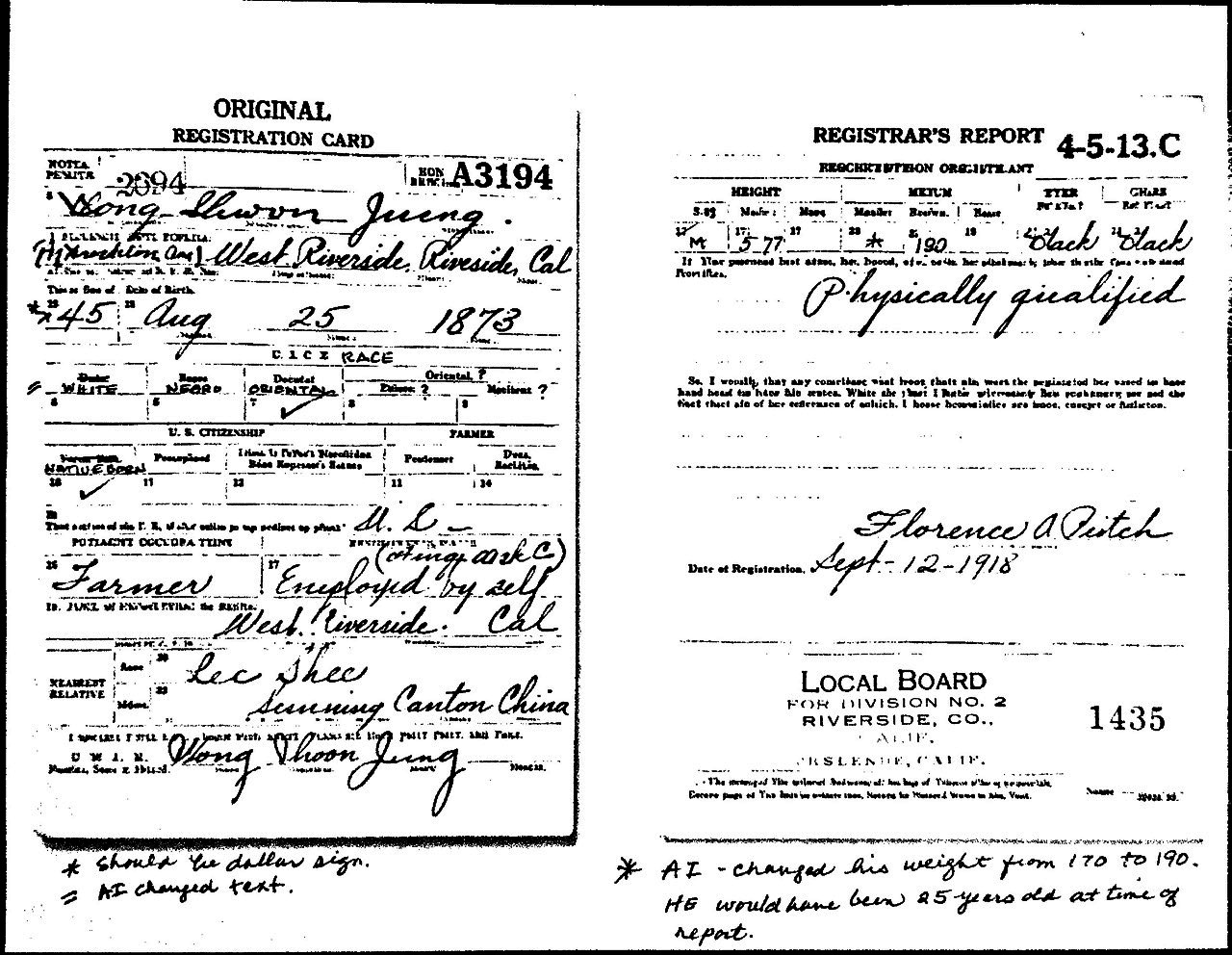
Company Man
P.T. Evans testified that he thought he had known Shoon Jung since at least 1900 (Pliny T. Evans interview 1915). The testimony was among the documentation Shoon Jung obtained for another trip to and back from China. To vouch for him, he got testimony from the youngest son of Samuel Evans, one of the wealthiest men in Riverside.
P.T. Evans’ family had leased property to Shoon Jung.
In 1901, 28-year-old Shoon Jung joined with several other Wongs to form the Wing Wo Company garden. They signed a five-year lease for 100 acres from the Evans family’s Riverside Land and Irrigation Co. Their garden was three miles from Riverside Chinatown and located between the towns of Colton and Riverside.
There were seven partners: Wong Ling, Wong Seong, Wong Hor, Wong Kim, Wong June, Wong Chung, and Wong Yen— and they hired 15 men to work in the garden (Wong Ling interview 1902). Wong Chung is believed to be a misspelling of Wong Shoon Jung.
Big-time Success

Source: National Archives
Journalist Harry Lawton writes in Wong Ho Leun that Wong Ben Chow (known as “Little Joe” and the father of Chinatown’s last mayor, George Wong), and Shoon Jung (known as “Big Charlie”) were the two best known Chinese ranchers/vegetable farmers in the Riverside area. Lawton was told that 200 to 300 Chinese worked for them at harvest time.
Their vegetable wagons were familiar to all Riversiders, and children ran out to greet them when they heard the hand bells shaken by the drivers, wrote Lawton.
Speaking to Lawton in 1959, Mrs. Fred Estes reminisced about Big Charlie giving gifts to his customers each year during the Lunar New Year.
P.T. Evans’ son Bill, also a Riverside mayor, remembered, “The vegetablemen always brought firecrackers around on their routes and gave them to us on Chinese New Year. They also used to give kids free tomatoes and other gifts. We thought they were the greatest guys in the world.”

Bing S. Wong recounted that Shoon Jung was a good friend of “old man Evans” and was “the only success in Riverside” because he made a fortune in a year on a good onion crop that he withheld from the market until prices were extremely high (B. S. Wong interview with Lawton in 1986).
A New China
We don’t know when Shoon Jung made his onion fortune, but he seemed to have been doing well for a number of years.
On a trip back to China from 1906 to 1909, he bought two acres in three lots of land for growing rice. This land was leased to Wong Show Gong of Gom Benn, with Shoon Jung’s wife collecting the rent. (Wong Shoon Jung interview 1915).
In this period, the Qing Dynasty finally fell after ruling China for 268 years. It was followed by the Republic of China, established in 1911. The new government struggled to modernize and unify the nation, battling with warlords for control.
Shoon Jung returned to this “new” China in 1914 during these uncertain times. Apparently he didn’t have much confidence in the new government.
Like Father, Like Son

He returned to California in 1915 with his only son, 15-year-old Quen Luck. As the son of a U.S. citizen, Quen Luck was exempt from the Exclusion Act, and allowed entry into California.
After being processed at the Angel Island Immigration Station in San Francisco Bay, he joined his father in Riverside and attended a local school from 1916 to 1917.
Quen Luck also lived a transnational life – bouncing between the U.S. and China. As a young adult, he, too, worked as a vegetable peddler and farmer, and made several return trips to Gom Benn.
His first return trip to China was in 1921. Quen Luck, 21, married Chow Yuet Lee (1903-2001) in his home village. A year later, they had a son, Jimmy Fay Hong Wong 惠棠/正义 (1922-1957).

At this point, Shoon Jung was about 50 years old, and ready to retire. But where? Although Shoon Jung was a U.S. citizen he could be harassed, treated like an “alien,” and threatened with deportation. Moreover, Chinese women were discouraged from coming to the United States. Shoon June couldn’t easily reunite his family here.
So, the choice was clear.
Glory Days
For most Chinese migrants, the ideal scenario late in life would have involved retirement, returning to China as wealthy individuals, and dying in the home village; Historian Michael Williams (Williams 2018) describes this aspiration as “returning home with glory.”
Shoon Jung appears to have been one of the few who fulfilled that desire.

With his relative wealth, he returned to Wo Hing village in Gom Benn in 1925; he briefly returned to Riverside in 1927 to cash out his remaining money (Wong Ho Lung interview 1934).
Back in China, Shoon Jung built a three-story home – his dream mansion. Maybe he was inspired by the magnificent homes he’d seen in San Francisco as a child, or maybe it was the showy homes owned by the citrus growers in the Inland Empire where he had delivered vegetables.
But now he was the master of his own towering mansion.
It would have been nice if Shoon Jung, surrounded by his wife and granddaughters, lived his final days in peace.
But no.


the 15 houses in 1914. Wong Shoon Jung’s mansion is structure No. 62. Source: Laura Ng’s Dissertation
More Chaos
Another Chinese civil war erupted in the summer of 1927 with fighting between Mao’s Chinese Communist Party and Chiang Kai-shek’s Kuomingtang government.
For Shoon Jung, moving back to the United States was probably out of the question. In 1929, the U.S. stock market collapsed. The Great Depression spread into a severe global economic downturn from 1929 to 1939. There was widespread unemployment and poverty, and bank closures and business failures around the world.
In 1931, the Japanese invaded Manchuria in northern China. In 1937, the Japanese attacked much of the rest of China, taking control of major coastal cities and the capital in Nanjing.

Hard Times
With China at war with Japan, communications and remittance from the United States were cut off. Years later, Shoon Jung’s granddaughter Sun Woo recalled these tough times. When she was 7, she, and later her sister, Shook Hing, learned to grow rice in the paddies.
Except for rice, food was scarce. Sun Woo also took old clothes, removed the stitches and re-sewed the clothing inside out for sale. The clothing was faded on the outside, but inside the cloth looked new. She walked many miles to neighboring counties to sell her refurbished clothing.

Meanwhile, Shoon Jung and his wife Lee Wun operated a small grocery store named “Baochanglong”(宝昌隆) in Gangning (岡 寧墟), a few miles from Gom Benn, recounts his great-grandson Chris Lau. They were later persuaded by an ill-intentioned close relative to entrust the shop to him.
But, in less than a month, the shop was found completely deserted, fulfilling the old saying, “You can guard against thieves day and night, but you can’t guard against a thief within the family.” (日防夜防,家賊難防).
With the help of the granddaughters, the family reopened “Baochanglong.”
The End
In 1942, there was a major infectious disease epidemic throughout the Taishan region. Shoon Jung contracted typhoid fever and passed away at the age of 69.
Chris Lau writes of his great-grandfather: “His journey from a Taishan village to the farmlands of California and back again is a testament to unwavering hard work. He not only achieved the American Dream of wealth but fully realized the Chinese dream of returning home as a respected figure.

“The diaolou (碉楼 ) (mansion) and other houses he built still stand in Wo Hing, physical proof of his remarkable life and a profound connection to a past that continues to shape the present for his descendants.”
*Note: Much of this article is based on research by Grinnell College Historical Archaeology Professor Dr. Laura W. Ng. She wrote her 2021 dissertation at Stanford University on An Archaeology of Chinese Transnationalism, which explored the links that Chinese migrants maintained between their home village of Wo Hing in Gom Benn, China, and the Chinese-American communities they established in Riverside and San Bernardino, California.
Thanks to Dr. Ng for her help. Also, thanks to Wong Shoon Jung’s great-grandson Chris Lau, and great-granddaughter Elaine Lee for their very-much appreciated contributions and assistance.


